Wednesday, February 17, 2021

Singlehanded Three Bridge Fiasco!

The last 2 years I had crewed on another boat to be able to do some of the races. So this year thanks to the pandemic there was only going to be singlehanded entries for this famous race, and I thought I give it a shot with Constance. Now the Three bridge fiasco is a very tough race for an old and heavy boat like the Tartan34C. Huge currents around the SF Bay, paired with usually low winds make this a long and challenging day, even when sailing doublehanded.  In order to have any chance to make it around the course, you really need the spinnaker, which is quite a challenge when singlehanding. My autopilot had some technical issues just 2 weeks prior and I decided to replace the wheel parts that had degraded significantly, skipping, not disengaging etc. For the spinnaker work you really need a reliable autopilot!
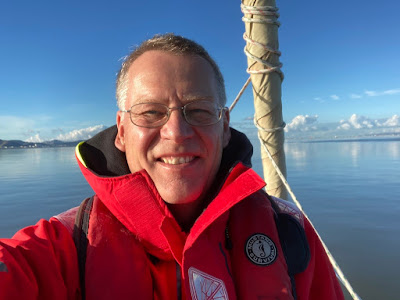
motoring towards San Francisco

My start time was 9:35a, so I needed to be in SF the night before to make it to the starting line. That meant I needed to rush after work to the boat, motor or sail down to San Francisco and anchor overnight.  Of course all singlehanded! That worked pretty well except that my roller furling line had frayed and started to get stuck in the furling unit! Thank God for Ducktape! So I fixed it provisionally and it held well for all of the race, where I ended up setting and dowsing the spinnaker multiple times and of course furling and unfurling the jib multiple times. 

The forecast was for a small flood and a modest SE breeze in the morning. So my plan was to do a spinnaker start and sail against the current close to the shore over to Blackaller first, then go to Red Rock on the flood tide and hopefully make it around before a monster ebb would set in. Of course no plan survives the contact with reality. The flood was much stronger than projected, plus there was virtually no wind. I ended up having a good start right on the money by just drifting across the line with the flood current. No way I could get to Blackaller that way so I set course for the Red Rock in the fickle breeze instead. I picked up some nice breeze around Alcatraz and went to set the spinnaker. Of course the lines were not set correctly so I had to spend some time on the foredeck to untangle things. 

By now a lot of boats had followed me and were overtaking me, most of them going around the Southern Tip of Angel Island. I knew that there is always a wind hole behind Angel Island so I opted to go through Raccoon strait instead, with few other boats. That worked perfectly well and by exiting the strait I saw that everybody else was stuck in  said wind hole. Ha! The breeze continued to decrease but the flood tide was pushing me gently towards the Red Rock. As I was almost there, the wind completely died and I got just as gently pushed past my rounding mark and beyond underneath the Richmond Bridge. Crikey! Nothing I could do, was thinking of anchoring but not a good idea in a place with ferry traffic. 

My nemesis, the Red Rock. So close and yet so far

It took me 2hrs going back and forth trying to hold my ground somehow until the wind kicked in again, this time from a westerly direction. Now the irony was that everybody who got stuck in the Angel Island wind hole had drifted to the Red Rock just in time when the wind was back up and rounded just fine. The usual few boats that cut it too close and had to abandon the race, but they mostly made it around about 1-2 miles in front of me. I was pissed! To catch up I threw up the spinnaker even though the angle was a little hard but I knew it usually clocks back as you traverse between Angel Island and Treasure Island. 

The lesson I was taught next was to never set the spinnaker on a half wind course when single-handing! The moment the spinnaker filled, I rounded up nicely while hanging on for dear life on the foredeck! The autopilot wouldn't hold course no matter how much I yelled at it! I finally made it back to the cockpit, adjusted course and was on my way again. So for setting the spi you really need to bear down quite a bit to make sure the autopilot can handle it. Oh well.

Big Blue is up!

I made it nicely to Treasure Island after that and was even able to pass a couple of boats. About 4:30p I was under the Bay Bridge, and from there is was easy running down with the ebb tide and a light westerly breeze. By 5:30p I was already at Blackaller, which left me 90min to claw back 0.8 miles back to the finish line in front of Golden Gate YC, before the time limit at 7p. Except. The tide was big and the wind started dying. Oh well, I hugged the shore, set the spi again and inched my way back. The sun had set by now and I was still not anywhere close the finish line. I inched past Anita rock with less than 0.1knots over ground while throwing a nice bow wave. And all the time the wind was getting less and less. I frantically wing on wing'ed the spinnaker with the main, that helped a little, but at 6:55p I was about 50 yards from the finish line. I hailed the race committee and they actually had mercy on me, letting me finish at 7:02p, with a horn and everything! Phew! I was the last boat to finish, but about half of my division had abandoned the race earlier. 
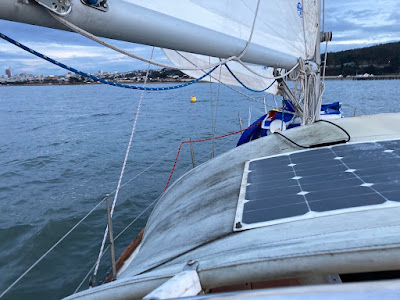
The last mark, Blackaller buoy

I opted for staying overnight again at Aquatic Cove anchoring. Unfortunately there was already quite a number of boats in there. I picked a spot, but after setting the anchor I realized I was too close to another boat. Anchor up again, with pure muscle heft, since I don't have a windlass. By now I was really running on fumes, having had 2 bagels to eat all day including breakfast. After finally being securely anchored, I had a nice IPA or three and sank into the bunk without further ado :-). 

Haven't posted in a long time!

No, this blog is not dead, it was just that we had a lot of distraction the last 3 years with a little baby on board now :-). 

New crew onboard!

So what has been going on with Constance meanwhile? We haven't taken her out for many trips, really only when we had visitors so that someone was always there for the little one.  I spend some $$ on fixing and upgrading stuff: 

- Installed a new solar vent in the place where the front deck dorade was. That vent starts working whenever the sun is shining and sucking out air from the boat. As a result the boat is much drier inside and we didn't get much mold in the winter any more. 

- Installed double life lines to be offshore compliant

- Replaced the steering cables as the old ones started to fray

- The roller furling unit broke so I had to buy a new one (Profurl C230). That also came with a new somewhat stronger forestay (9/32"). Also replaced the wire jib halyard that had some kinks in it. 

- Replaced bilge pump with a unit that has a check valve to prevent syphoning into the center board trunk. 

- Got a new main sail cover and front hatch cover.


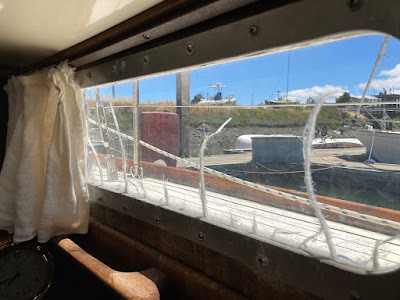
- Replaced the starboard windows with Lexan. They started getting cracks and were leaking. 

Cracked windows before..

.. and after fixing!


Tuesday, February 21, 2017

3BF!

Time of the year again to venture out on the Bay for the Three Bridge Fiasco! This year we had beautiful sunshine and 360 boats on the line in one of the biggest sail boat races in the US. Unfortunately we also had a nice New Moon (Happy Chinese New Year!), which results in horrendous tidal currents. On top of that, the plentiful rain this winter results in quite some run-off, magnifying the ebb currents significantly. With that in mind I decided to round the Red Rock next to Richmond bridge first, before the flood current would run out around 11a. After that I expected that the fickle winds around Red Rock would have us stranded there fighting the ever increasing current.

The starting area. As usually manymany boats and little wind
Our starting time at 09:35:45 (this is a pursuit race) gave us just 1.5hrs to cover the 6 miles to the Rock, so straight there was the objective (in hindsight that was a mistake, but more of that later). The wind was blowing steady out of the NE at 5-10kn with some gusts up to 15kn. We made good progress and saw the rest of the fleet opting to fight the flood current and round Blackaller Buoy next to the Golden Gate first. Hmmm. At least that made us go first through Raccoon straight without having to cross-tack with many other boats. Rounded Red Rock around 11a, just as planned, with quite enough wind to make it just fine. Spinnaker went up, without twists and snags (!), and off we went to our next target, Treasure Island. 

Skipper still happy. Things are slowing down...
That's where it became interesting. The wind was forecasted to fill in behind the Berkeley hills only by 2p, and sure enough ahead of us was a big dead zone extending to the horizon. Some fast boats had already reached that line and were sitting there motionless. Eventually all boats around us got to that line and about 200 boats were sitting there becalmed. It was quite an amazing sight, the line was so abrupt that it was like a starting line to an Olympic race, except all sorts of different boats, spinnaker or no, big and large. Then the ebb current started setting in and I noticed we were drifting backwards at 1kn. Thankfully it is relatively shallow there and I could deploy our stealth anchor. A number of boats drifted backwards and there were some tense moments where collisions were almost imminent. The number of boats announcing withdrawal from the race attested to that. After 1 hr parking we started moving again, only to be parked again at the North End of Treasure Island.

Sailboat parking lot extending a mile to the right..

..and all the way to the Berkeley shore (it seems) to the left.

By now even the slowest boats that had opted to go around Blackaller first had caught up with us. So in hindsight we should have done that too. Oh well. Nothing that could be changed now, the next thing was to get around that blasted Treasure Island against a raging ebb current. I saw a bunch of boats solidly parked on the left (eastern) side of the channel where there was obviously no wind. The boats in the middle were struggling against the current whereas the boats next to the shore of TI seemed to be doing best. So that's where we went, even though I knew there were some risks to that too, like getting pinned downwind on port tack or running into some windless eddy under the bridge later.
Big Blue still flying..
Things went relatively smooth until we went under the Bay Bridge around 3p. That's where chaos unfolded, the raging current and boats abreast on different tacks was really difficult to handle. Plus in light winds our A-sail doesn't like to gybe, and gybe we did multiple times due to boats and other obstacles. Every time we had to gybe the spinnaker lines got tangled on the bow pulpit and we lost speed. My faithful crew was getting quite desperate in the tangle of lines on the front deck! I tried frantically to get to free air by gybing through the fleet onto the other side of the channel, but on port tack with so many boats around it was not possible. In the end I was just happy we got spit out off the back of fleet, not having collided with anybody. Some boats even collided with the Coast Guard cutter anchored on the SE corner of TI. The Coasties were not happy at all!

The next drama came when we went around the southern corner of TI. We ended up being somewhat too close to the island and got swept into an eddie at the Western shore. Some other boats got so close to land that they had to switch on the engine and bail out. Thankfully we got a puff of air just in time and were able to clear. Phew! By now it was 4p. But only riding the ebb current down to Blackaller and back 1mile to the finish! We set the spinnaker again and blazed down at 8-9kn with a nice beam reach between Alcatraz and the SF shore and the rest of the ebb current behind us. I opted to take down the spinnaker early to make sure no entanglement would prevent us from rounding and then risking getting flushed out of the Golden Gate. But approaching Blackaller we all of a sudden slowed down a lot and I realized that there was a very strong flood current, at least 4kn, around Blackaller! It took us 30min to get the last 200yards! after that it was taking back and forth to the finish line which took us another hour (since there was still an ebb current running everywhere else!). 18:04 was our finish time, 55min to spare, but not too many boats behind.

At that point I was totally exhausted, my left hand had started to cramp and became a rigid claw not being able to grab the steering wheel even! We dropped the anchor in nearby Aquatic Cove and went to bed after an early dinner, sleeping like logs. That night we said "never again", but I'm sure we'll be back next year ;-)

Wednesday, July 6, 2016

4th of July cruise!

Long weekends are always nice for cruising around the Bay and taking some time to enjoy the scenery. We left on Sunday morning from San Mateo's Coyote Point. Now this time of the year is when the summer winds kick in. The huge temperature difference between the Central Valley and the coast results in a big pressure gradient, with winds funneling through the Bay from the West. Usually that thermal gradient wind sets in around noon, and can reach gale force in the late afternoon. Usually it tops around 25-30kn, but we've seen wind above 40kn. So nothing for novice sailors for sure. As we motored through the entrance channel I notice a mast sticking out of the water in the shallows. Looks like somebody got unlucky! That's why I always keep the main up before motoring through there. There is usually a strong cross current that will set you in the shallows in case the engine dies. Somehow around Coyote Point in can get very gusty, not a good place to be in trouble!

Coyote Point channel entrance with sunken sailboat
We left relatively early in the morning to catch the favorable ebb tide towards SF, and I was kind of expecting to motor most of the way until the thermal set in. However, it was blowing already 15kn when we left! In anticipation of bigger things to come we tucked in a reef and went on our way. Once we passed under the Bay Bridge 2 hrs later we had the full thermal going. There was hardly any sailboat out, despite the holiday weekend! Sustained wind of 20-25kn with higher gusts! We were so busy driving the boat that I almost missed that we were overtaken by a huge container ship. Quite impressive!

Container ship leaving the Alameda estuary


25kn wind speed! 
We finally anchored at Belvedere cove. This is our private spot as not many boats draw only 3'11" like the Tartan34C (with the centerboard up). At low tide it gets down to 4ft water depth and we have seen some boats getting stuck. Hence nobody there, a million dollar view and perfect tranquility! Check out the image, out towards SF the water is churned up, whereas inside the cove it is almost glassy. We have 35lbs CQR with 30ft of heavy chain and 120ft of rope. We usually pay out 60ft in shallow water like this, and so far that anchor has never dragged. Even in places like Block Island we never had a problem with this setup, while other boats were dragging around us. 

Anchoring at Belvedere 
The next morning saw us catching the morning flood back home. Beautiful weather and a speedy ride thanks to currents. Check out the current trail in the picture below. This is at Blossom Rock, right in front of Pier 39. I estimate the current to be 3.5-4kn in that location. The thermal had already set in, but only around San Francisco. Once we reached the South Bay, the wind veered Northeast, and we had a joyful ride back home.

Huge flood current at Blossom Rock
Finally, no 4th of July without Old Glory!


Wednesday, May 4, 2016

Round the Rocks!

Last race of the Singlehanded Sailing Society inside the Bay this spring! Round the Rocks starts at the Berkeley Olympic Circle, then clockwise in the Bay, rounding Alcatraz, Harding Rock, through Raccoon St, past the Red Rock, around the Brothers all the way in the North, back past Red Rock and to the finish at the Richmond YC. 

Last year we were pretty successful, catching up with lots of boats that were parked in front of us. This year promised to be a nice day with enough wind to keep us moving around. When we got to the starting line, a gentle North wind was blowing, indicating a spinnaker start. The flood started flowing and this is where I made the first mistake, placing us down stream from the starting line. 

There was already a big cluster of faster boats close to the starting line, they were starting in several groups ahead of us. With 5min to go I was about 200yrds from the starting line. That's when the wind completely shut off and everybody was drifting away from the starting line. Also the wind had switched from N to W, making it a classic upwind start. With the massive forests of masts parked in front of us there was not a chance any wisp of wind would reach us though! 

I quickly got the spinnaker gear down and set the jib, but we didn't make any progress, maybe just 1kn through the water while the current was building and pushing back by about the same rate. It took us 50min (!) to cross the darn starting line, with the wind shutting off once in a while, while slowly building n general. Unfortunately the flood was building, too, so we were almost dead last out of the fleet of 100+ boats at the starting line. 

Finally a wind field arrives!
We managed to reel in a couple of boats on the way to Alcatraz as the wind finally went above 10kn and we stayed behind Alcatraz in the current cone. Rounding Harding Rock was another disaster as the current had build up to 4+ kn and we missed it by a hair, having to tack back forever against the current. Finally the spi  went up and we went through Raccoon strait, looking at the fleet from behind. It kind of looked as though we would be able to catch up, as everybody was parked by the Brother Islands. 

Alas, no such luck, the wind just picked up enough for everybody to squeeze around and finish way ahead of us. We got 5th last out of doublehanded monohull (#53 out of 66 started boats), and last to finish in our division. Even Galaxsea, a big gigantic Nauticat 44 full keel ketch that rates higher than us despite 1.5x the water line, corrected out on time in front of us. They usually have even more problems in light wind than we do, so that tells me how bad we were :-). Anyways, was a fun day on the water, beautiful weather despite the agonizing race. Learned something for next time!

Wednesday, February 17, 2016

Three Bridge Fiasco!

As the reader of this blog already knows we're a big fan of the annual Three Bridge Fiasco race, even though we haven't been able to finish in the last 2 years, and have been last boat to finish in our first attempt in 2013. In 2014 we got sucked out of the Golden Gate and crossed under that bridge 9 times before giving up. Last year we went into a gigantic wind hole and never made it around Red Rock, after having rounded Treasure Island first. Still, it is really a fun race and quite a challenge to figure out the right course. 

To recap the rules: This is a shorthanded race (only 1-2 people allowed on the boat), takes place in the San Francisco Bay, and requires the participant to round three marks in the vicinity of the 3 big bridges, the Golden Gate Bridge, the Richmond Bridge, and the Bay Bridge. The order of which is up to the individual boat. Also, the direction in which you pass the start & finish line off the Golden Gate YC is up to the participant. On top of everything, this is a pursuit race, so each boat has an individual starting time, based on speed rating. With the huge popularity of the race (>300 boats), that creates quite some interesting scenario especially at the start, with boats going every which way. Hence Fiasco!

The other thing that complicates things tremendously is the tidal current situation. The SF Bay is a complex tidal system, with South Bay, North Bay, San Pablo Bay creating a harmonic oscillation of water flowing in and out. Throw in some islands and channels to make things more interesting. Also, (and more of that later) this year's El Nino winter has dumped quite some precipitation on the sierras, resulting in quite a runoff channeling through the Sacramento River and North Bay.

The 3BF starting area

Our starting time was 9:35:45 in the morning, with the ebb running until 11a. That, paired with the light winds made the first mark pretty clear: Blackaller Buoy next to the Golden Gate. We got a quite reasonable start among the mess of boats shutting down the wind on the starting line, and drifted/sailed slowly to our first mark.  The wind was supposed to fill in from the NW, changing to W, but when we rounded the mark it was really more like a North wind at 5-10kn. So, no need for the spinnaker, at least initially. I was thankful that we changed the foresail to the 125% #2 jib, past experience has taught us that the winds are fickle around this time of the year. The plan was to round the course clockwise, going to Red Rock 2nd and Treasure Island last.

When we went past Sausalito, the wind veered West and you saw the skipper running up front to hoist the spinnaker. Everything was already setup before the start of course, anticipating the westerly, and I had REALLY checked all the lines twice before we set off. The more stunned I was when the halyard was wrapped around the lifelines and the lazy sheet was wrapped around the bow pulpit. How could that have happened! While I was wrestling with the lines the wind kind of died and therefore we didn't lose too much, bareheaded with a tangle of lines on the foredeck. I finally got everything cleared only to realize that the wind had changed 180deg and we had to quickly gybe with hardly any wind. As soon as that was done, the wind changed back to N, so down came the spi as it was now upwind sailing again.

I probably burned about 5000 calories right there and achieved close to nothing. At least I had the mess of lines cleared up front, something that should pay off later. We went relatively uneventful through Raccoon channel and tried to harden up into the northerly breeze on the way to Red Rock. By now the ebb current should be abating, right? Unfortunately I found that despite a nice angle towards Red Rock we were pretty much crabbing sideways, swept down by a vicious ebb current of at least 2 knots. I didn't realize then that the Sierra run off was increasing the ebb current. As we were swept to the Richmond side, the current finally got less and we could point pretty well towards Red Rock. I saw that most people tried to round the island clockwise, but I thought to be smart and went counterclockwise, anticipating a flood current pushing us past the windless Eastern side of the Rock. Windless it was indeed, but there was absolutely no end to that ebb current! So everybody else sailed happily past us on the way to the next mark and I had to hear some sarcastic comments from the 1st mate what kind of fantastic plan I had come up with.
Constance on the way to Red Rock

The Red Rock. Notice the windhole on the right side
Richmond Bridge in the background
Last year we got stuck here too and I was already having deja-vues. But there was a little wind left and I stayed as much as I could out of the wind shadow of the rock. Some other boats tried to cut that corner and got helplessly stuck in there for a long time. So we finally rounded, and set the spinnaker. Like everybody else that had sailed away from us already. 
Looking at the fleet from behind
Now something very curious happened: I noticed that all the boats that had passed us earlier, were stuck in that nasty windhole we just emerged from next to the Richmond wharf. There was people calling the race committee to sign off as they had drifted into the exclusion zone next to the oil dock. No way I was going in there again! So I stayed as high as possible, supposedly driving into the building flood current of the main channel (which however never materialized). Also, the wind really started to fill in, from the West. It reached us with quite some vigor and miraculously never reached the remainder of the fleet parked by Richmond.  So we sped up handily and passed about 50 boats within less than 30min. They must have been totally agonizing to see us zoom past!

Catching up with Big Blue barely pulling
Halfway to TI the wind build up to 15kn so I quickly dowsed the spi as it was halfwind anyways, and the jib was going to do just as fine. Going around Treasure Island was relatively easy as the wind had build enough. Now we had to fight the building flood current on the way to the finish, and we decided to go into the cone behind Alcatraz instead of fighting the current with less wind along the SF Piers. That worked out pretty well even though we had to sail some longer distance. We eventually passed a couple of boats that were in front of us at TI. Totally exhausted, we passed the finish line 16:24:30, after sailing about 25 nautical miles total. 

Looking at the score, we couldn't believe it: We came in 5th out of 33 in our class! Overall #183 out of 304 doublehanded monohulls. Doesn't sound too great, but for us finishing at all is already a lot. For the night we anchored at Aquatic Park. Had some nice dinner and fell asleep like a rock :-)

Friday, October 16, 2015

45+ knots!

Highest wind speed so far on this boat. Front came through and added to the thermal on a otherwise normal day on the SF Bay. Wind peaked around 4p with 35kn sustained with gusts above 45kn on our wind speed indicator. 2nd reef in the main with the boom vang way off and the J#3 rolled up to 30% was still enough to produce some crazy round-ups. Good news: nothing broke. This boat is tough as a brick in heavy weather! No pictures, we were way too busy!

Tuesday, September 22, 2015

Labor Day Cruise!

Some pictures from our cruise on the SF Bay over the Labor Day weekend. After a great sail around the water front and Alcatraz we stayed overnight at Belvedere Cove / Tiburon. That anchorage gets a little rolly once in a while, but you're all on your own as the depth is only 4-6ft at low tide. No problem for the Tartan 34C with the center board up! The views at sunset of downtown San Francisco are nothing short of spectacular. Next day we ventured out of the Golden Gate since the weather was really nice (no fog!), and the tide was cooperating nicely. Out there it is a different world, very tranquil, actually much less wind than inside the bay, believe it or not. We saw plenty of marine life and I tried my luck to catch some of the salmon, but alas, to no avail. After a total of 75miles crisscrossing the Bay we were pretty exhausted returning home! 
Anchored at Belvedere Cove
Outside the Golden Gate!
Salmon catching efforts..

Wednesday, July 22, 2015

More maintenance!

Did a couple of necessary repairs and upgrades over the weekend:

1) Replaced the broken exhaust elbow with a new one. The tricky part was to get all the hoses off the old part, and back on the new part. Also the bronze fittings were really snug and I was a bit concerned that I would crack the cast iron elbow by applying too much pressure. In the end it all fit ok, engine is running smooth and no exhaust fume is escaping into the cabin no more!
New Elbow

2) Replaced the old single wire stanchions with double wire stanchions that comply with offshore recommendations. The tricky part was that the sockets were all different so I had to drill many holes and tap threads like a champion. The next step will be to install new lifelines. The old ones are of the vinyl coated variety with lots of rust stains where they pass the stanchions. Yikes! Not something you want to depend your life on.

3) Replaced the mast boot and the partners. The old partners were kind of worn and allowed the mast to pump quite a bit on a beam reach, and the boot had cracked from age in some places. I bought a Spartite kit, which forms a continuous barrier around the mast and should completely stop it from pumping. Spartite is some sort of 2 component epoxy, that is applied while still liquid and then cures in place. The tricky part here was that it needs to be poured in the gap between mast and deck. For the still liquid mixture to stay in place before it cures, there must be no leaks to down below, otherwise the whole goo goes down into the cabin. Now, forming that barrier is quite tricky as there is very little space in some places. The kit comes with some sort of a playdoo clay that settles in corners and crevices. I thought we did a pretty good job, but just to be sure I positioned the best crew of all in the cabin below to watch, equipped with paper towels etc to stop any drops. Then I poured just a tiny bit and watched the level. From downstairs I got the all ok hail and I went to pour some more. And some more. That's when all of a sudden the level started sinking at an alarming rate, followed by a cry of disgust from down below. The stuff must have broken some crucial barrier and was now emptying out of that hole. Argh! I rushed below and helped putting wipes and tape in place to stop the ingress. In the end it wasn't so bad, except the blue sprinkles all over the place, in my hair, face and pretty much everywhere. No picture of that mess, sorry :-)
I should have just waited until the stuff settled a bit, but I was afraid for that to happen too quickly and then I would have ended with a solid piece of plastic in the mixing bucket, and none next to the mast. The instruction said you have 7-15min under normal conditions. And that was a pretty warm day to begin with, so I figured less. So hurry hurry, but in the end I could have waited. It was still pretty easy to pour after 10min or so, more like honey. Oh well, next time.. The mast boot was comparatively easy, just roll the self adhering tape around a couple of times, install the clamps and voila!

4) Installed the hardware on the boom for the 2nd reef. We figured that we really need the 2nd reef installed permanently, quite often we do see winds above 30kn here which absolutely requires 2nd reef. 

5) Cleaned up the mess from the spartite experiment. 

6) Drank some beers!

Thursday, July 9, 2015

Memorial Day Cruise!

The long weekend of Memorial Day was a great chance to get out of our usual SF and back routine and visit some places we haven't been to for a while. I checked the tide tables and coincidentally, it was just a perfect fit for a venture out to the North Bay! The morning ebb would take us nicely to SF and the afternoon flood then would flush us up through San Pablo and further up wherever we wanted to go. We decided to visit our old stomping grounds of Benicia, so many beautiful memories! 

To get out early enough (noon slack water at Treasure Island!) we spend Friday night on the boat and set out early in the morning after breakfast. I was expecting to motor at least some part of the distance, so we had brought a spare canister of Diesel, just in case. However, the wind was already setting in early in the morning and we ended up motoring only for a little stretch close to the Bay Bridge. We even ran the spinnaker pretty much all the way to early afternoon, where it started to gust up in the usual afternoon thermals setting in. At Berkeley Circle we made a little detour to say hello the the J24 state championships, where a friend of us was competing. They were struggling with fickle winds and strong currents, but with the help of the iron genny we were quickly out of there and started sailing again.

Under gennaker close to Richmond bridge

Cruising the North Bay, SF skyline in the background
Going through San Pablo Bay was a breeze, wind and current in the same direction usually means flat sea state and a very smooth ride. Beautiful! Seeing the familiar silhouette of the Carquinez bridge reminded us of the time 3 years ago when were sailing this stretch of water countless times. Of course, and just as usual, as soon as we entered the strait the winds sort of died, but we enjoyed sailing slowly along the beautiful scenery, pushed by the current, and finally docked at Benicia harbor. After a walk through beautiful downtown Benicia we settled for dinner at Sailor Jack's, a really nice restaurant offering creative and high quality seafood dishes in a very relaxed atmosphere. They are located on the water front, offering splendid views of the sun setting over Carquinez Strait. 

The way back wasn't going to be that easy, as we now had winds against us and the ebb too early to be useful getting all the way to SF. Already in the morning it was blowing quite hard and we decided to tuck a reef in right away. Just outside the bridge where the Bay opens it got really messy, the strong ebb tide against 25kn of wind created a huge chop. The boat was slamming down pretty hard into the waves, so we decided to get out of the main channel to have a little smoother ride, even though it meant being somewhat slower. We saw some boats deciding to go under bare poles, engine only, slamming up and down the waves. Good stomach training :-) Around Pinole point it probably blew the hardest with gusts in the 30s. But as we neared China Camp the waves got much better as the wind doesn't have enough fetch to create any bigger waves. What a difference going through Richmond bridge, we really had to take that reef out to make any progress after that. After a long day we finally picked up a mooring at Angel Island, our favorite spot to spend the night. Nothing more pretty and tranquil around in the area.

Cuvee Constance for dinner!
The next morning it felt like being anchored at Moorea, as a pair of outrigger canoes came paddling by the lush green scenery that envelopes Angel Islands north flank. The way home was uneventful and we had to motor quite a bit to get home since there was way less wind than the day before. Just when we entered the Coyote Point marina channel I heard some strange noises from down below, as if the propeller shaft was rubbing against something. Otherwise the engine was running fine with full power, but I was glad it didn't happen earlier and was able to investigate right away. Upon further investigation when we were eventually docked, I also noticed a pretty bad Diesel exhaust smell inside the cabin, something I had noted earlier but attributed to the wind blowing exhaust back into the cabin. Happens sometimes when you run under engine down wind. This time however it was clear that it was coming from the exhaust system. After a quick check I noticed that the exhaust elbow was cracked. Good grief! No more motoring until that is fixed I guess..

Broken exhaust elbow, see the crack at the connection to the engine...

Monday, April 20, 2015

Round the Rocks!

The last of the SSS spring series races! Last year we did pretty well since the fast boats all parked in front of us until we had a chance to catch up. But this year that wouldn't happen, as the summer winds have already started. The race is fairly long at nominal 19.8 miles, plus we're on a new moon with raging currents in the SF Bay. Lots of work for a shorthanded crew! The start was at max flood, setting off from the Berkeley Olympic Circle towards Alcatraz (aka "The Rock)", then further up current to Harding buoy, then hopefully with some flood still pushing through beautiful Racoon strait, rounding Brother Rock all the way beyond Richmond bridge. Then past Red Rock and finally towards the finish line off Richmond YC.

We totally messed up the start (along with everybody else in our starting group), thanks to a huge current on the line. Took us a while to clear the line, but then off to the Rock! On the way there it breezed up quite a bit and over the radio we heard that Crissy field already had 23kn, so quickly in with the 1st reef! Took lots of tacks to finally clear Harding, but we weren't doing bad. The gennaker went up in a flash and we had a nice ride towards the Brothers. For some reason I set up the spi for outside gybes, and guess what, that works much better! We only messed up one gybe when there was little to no wind at the exit of Racoon. Lesson learned!

The last beat to the fish line was relatively easy, although we were pretty tired now. I was battling a Yankee 30 from our division which rates 20sec slower than us, so they had us beat on time for sure. When we were just about to pass the Richmond dock, a huuuge tanker decided to leave veery slowly, but of course you still cannot pass in front of him, so we probably lost another 5-10min there. In the end we were 2nd last in our division, but only 18min behind the leader, but 2nd overall on time, so I'm not too disappointed. Lots of fun sailing a technically challenging course! Results: here

Constance trucking upwind at 5.5kn

Tuesday, March 24, 2015

Corinthian!

The annual Corinthian race is the 2nd big race of the Singlehanded Sailing Society in the SF Bay. It is almost the same distance as the Three Bridge Fiasco (18mls vs. 22mls), but has a prescribed course zigzagging across the Bay (and avoiding the wind holes behind TI and around Red Rock!). At least that ensures that you're not constantly fighting the current but can also enjoy some down current speeds in between! Start is off the beautiful Corinthian yacht club house in Belvedere, across the Bay from San Francisco. There are 4 divisions (multihull, non-spi, spi, sportboats), with sub divisions for PHRF rating, double-handed and single-handed crews. We started in the Doublehanded PHRF 162 and above division. Constance rates at the top of that group with a PHRF rating of 165. On the East Coast I had 186, but of course the West Coast usually has stronger winds which favor our boat.

Corinthian YC in Belvedere
The day started early for us, leaving Coyote Pt marina at 6:30a, motoring against a growing  flood tide to be at the starting line in time. Just the day before was New Moon (solar eclipse in Europe!) and the tide currents were predicted to be monstrous. Which made me a little concerned, given that this time of the year the winds tend to be fickle! With more than 100 boats signed up for the race it was pretty crowded in the starting area. Also, the location in the Raccoon channel is very tricky, with big currents and shifty winds. Our original start was scheduled for 11:15a, coincidentally the time of max flood within the channel. Sure enough, the inflatable mark for the starting line drifted off so the start got postponed by 15min. Fine with me, as there was little wind and it seemed to be slowly building.

We got off to a great start, just off the club house outside the main channel, so I was trucking with the center board up all the way into Belvedere cove. At depth of 6ft this is a no go zone for all the deep draft boats! The trick is not to get becalmed in the cove, so you have to find a compromise between enough wind to keep moving and staying out of the channel to prevent getting swept backwards by the current. We finally cleared the headland ahead of plenty of larger boats from the previous starter group that had to stay in the channel. I plopped the CB down and off we went skirting the channel edge over to Richardson Bay.

All telltales flying, slightly off the wind, that's how the T34C likes it!

We stayed maybe a little too long on the Sausalito side, almost everybody else had already tacked over and was slowly disappearing towards Alcatraz on the way to the next mark at Blossom Rock. But at least that gave us some safety margin against being swept past the mark by the flood tide. In the end we could even set the gennaker to reach the mark!

Rounding Blossom Rock. © 2015 norcalsailing.com
After rounding Blossom Rock the next mark was Blackaller close to the Golden Gate all the way up against the current. We had to short tack along the waterfront, that actually went pretty well and we were able to pass a couple of boats. Counted 19 tacks on this leg! While being busy with tacking I had totally missed that the gennaker was set up for the wrong side. Took me a while to clear out the lines and meanwhile we got passed by everybody who had planned better and had the Spi running earlier. Bummer!

Unfortunately, the next mark off Southampton shoals, all the way across the bay behind Angel Island, was almost exactly dead down wind. That works pretty well with the symmetric spi, but the gennaker really doesn't go below 150deg wind angle, so we had to gybe a couple of times. Lost some more time with our abysmal 50% gybing success rate :) But in the end we kind of figured it out, so I have high hopes for the next race! I'm still learning the optimum angles, I believe I have to keep a gybing angle of about 75-80deg to get the best VMG.

The next mark rounding was again abysmal, the jib sheets had themselves tangled with the spinnaker halyard which I had uncautiously spread around the foredeck (was concentrating on packing the spi so we wouldn't lose it!). That took us another couple of minutes to figure out, but soon enough we were back under way going at great speed towards our next mark, Little Harding Rock. By now the wind had increased to 20kn so we also needed to tuck in a reef. Also, the current had switched and we were racing at 8kn over ground!

Towards the finish. Constance on the inside. © 2015 norcalsailing.com
Rounding the last mark before the dash to the finish, we discussed if we should just keep the gennaker down and sail with the jib & main for the remainder of the race. In 20+kn it seemed a bit risky to put it back up, but then I saw how everybody seemed to slow down in Raccoon channel. By now both of us were super exhausted. Since we didn't have anything to eat the whole day except some cookies I was running really low on fuel. On top of that, I was getting cramps in my hands, so it was quite an ordeal to get the spi back up. Anyways, we got it up and reeled in a pack of 20+ boats parked in the ebb current just a few 100m before the finish line. I had this genius plan to scoot into Belvedere cove out of the current and pass all these boats on the inside. Great plan with one flaw: there was really no wind inside the cove. Or rather it came from all sides. So back and forth I was gybing the spi to get the speed going. Meanwhile I was so exhausted that I couldn't even make a fist any more, so in the end I was merely clawing at the cloth to bring it over to the other side. Very pathetic, but in the end we finished! Due to all the mistakes we made, we didn't make it to the top of our group, a hapless #4 with 9min behind the leader. Still not too bad! Overall 40 out of 56 in the double handed monohull division. I'm glad we finished and didn't come in dead last!  

Race recap on jibeset!

The best crew of all!

Wednesday, March 4, 2015

Gennaker!

I can't believe what a difference the new gennaker makes. Setting up is much easier as you don't have to worry about the pole, same with setting and dowsing. Since the area is somewhat smaller (750sqft vs 880 sqft on the big symmetric spi) it stays easier to handle even in big puffs. It also helps that the main projected area is lower compared to the symmetric spi. The boat doesn't go into a death roll downwind, but I still get down to 135deg apparent, and up to about 60deg apparent wind angle. What I haven't figured out completely is gybing, that still has a success rate <50% meaning I end up with a twist or some stuck lines most of the time. Also, not closing the halyard shackle results in the spi come crashing down and the halyard zipping up :-( and me later on climbing the mast to retrieve it back.. 

Monday, February 9, 2015

3BF!

This year's Three Bridge Fiasco started out much better than last year's. We had a nice NE breeze at the starting line which brought us trucking past Alcatraz towards TI in very little time. The plan was to go first around TI clockwise before the main ebb tide would make it impossible, then reach Red Rock, then go back through the Raccoon channel between Angel Island and Marin, riding the tail of the ebb tide, and finally finish rounding Blackaller next to the Golden Gate and back to the finish. The weather forecast predicted a dying gradient NE, which would be later be replaced by a westerly sea breeze. 

Starting line 3BF 2015

The weather was absolutely beautiful, sun shining, temperatures way up in the 60s. Not bad for a January 31st! At the northern tip of Treasure Island we set Big Blue, the new gennaker. By that time we had well above 10kn of wind and I was a little flustered on the pitching and tilting foredeck. Sure enough, I let go of the snuffer line and with a sudden puff the gennaker filled and pulled the sock all the way up, including snuffer line. Oops. That meant a complicated dowsing operation underneath the bridge, something I was not looking forward to. We went all the way across the channel to get out of the current and made nice progress towards the Bay Bridge. Sure enough the wind died closer to the bridge and our progress came down to inches. The good news: The gennaker snuffed itself without any outside help, so I was able to grab the snuffer line and set it up correctly. That was a very lucky turn of events! Some other boats that stayed in the channel and initially had pulled away, were now slowly swept back and eventually abandoned the idea of crossing the Bay Bridge. We made it all the way to just outside the Alameda channel, where we had to anchor for a little while. Eventually the westerly set in and we were able to make it past the southern tip of Yerba Buena island, sweeping at great speed under the western span of the Bay Bridge, woohoo!

So far so good, it took a little longer to get around the Bay Bridge obstacle as it was already noon now. The way to Red Rock was initially easy, first close hauled, then the wind was gradually clocking back and we could set the gennaker again. As we past Angel Island, the main fiasco fleet emerged out of the Raccoon strait. Apparently, the wind had died just after our start and everybody else was forced to go downstream with the tide towards Blackaller buoy. Many unfortunate boats got swept out of the Golden Gate, just like us last year, but some 100+ boats made it through Raccoon.

Unfortunately, as we neared Red Rock, the wind got less and less and completely shut down about a mile south of it. A huge parking lot of boats desperately trying to dodge the current and catch some wisp of wind emerged just south of the rock. That's where we stayed for about 5 hours until we called it a day at 5:30p, with no chance to reach the finish line any longer (7p was the cut off). Looks like only a little more than 40 boats out of about 350 starting boats actually finished. Those were mostly fat boats that picked Red Rock as the first mark and made it around before the wind shut off. Not sure if we would have been able to make it tough with Constance, she is just a bit too heavy to excel in light winds. 

Still, we had a lot of fun, and spend some nice days on the water! Next year we'll make it all the way around!
Making our way towards Red Rock (thanks to Mike from Roxanne!)


Monday, January 26, 2015

Big Blue!

Is my new G1 asymmetric gennaker. First test sail at little to zero wind was not 100% convincing but at least I got it to fly and was able to make some sort of speed with it. Jibing is somewhat more difficult than I imagined, it still needs someone on the foredeck to help the sail around. Let's hope next weekend at the three bridge fiasco there'll be more wind!

Sunday, January 11, 2015

Going solar!

Spent the last couple of weekends installing a new solar system on the boat. Since there was very little wind for sailing! Why solar now? Answer is relatively easy: I don't really like to be dependent on shore power and I also don't think it is a good idea to run the engine just for charging the battery. We end up staying quite often overnight somewhere outside with the boat and the batteries come down quite a bit with the anchor light on all night. Usually we would run the engine for less than 15min to get in and out of the marina/anchorage, so that's clearly not enough to get the batteries recharged. But if the wind is right, why have the engine drone on? But that's what usually happens, otherwise you run into danger of draining the batteries too much, damaging them in the progress. 

Nowadays, they have pretty affordable flexible panels available for less than $140 each, so I thought I give it a try. These are the same panels sold under the brand name of Solbian, but I got them much cheaper on eBay. 50W each, which is quite impressive just thinking a couple of years back. The biggest investment was the charge controller from BlueSky Energy, which came in at $292, but is also capable of supporting bigger panel arrays, and has some nice features boosting the panel output. I figured if I ever want to go on an extended cruise I would need some means to be able to recharge without shore power, so that leaves me the option to upgrade the panels if necessary. 

The next question was where to mount the panels. The only place that is not interfering with handling the boat and sails is really on the top of the spray hood. That's where the flexible panels come in handy. Of course you don't want them flexing back and forth, but I think the installation is rigid enough that it shouldn't affect lifetime too much. For now the panels are mounted using sewed in industrial strength Velcro. I probably need to reinforce the corners a little, but that can come later.

Today was the day when I finally connected the first panel. 1.1A from the get go on a hazy late afternoon, not too bad! After adding the second panel I should have enough juice running to never ever having to run the engine again for charging, hooray!

Solar panel installation (still need to hide the cables)
Hooray, 1.1Amps!

Monday, November 10, 2014

3000 miles!


..left in Constance's wake since May 2010! Quite some distance, further than crossing the Atlantic Ocean between America and Europe! Time to reflect on the things I learned, since this is the first time for me owning a boat. So, here is my list of aha moments:

Buying a boat:
- You need to be clear what kind of sailing you will do. If you're planning to competitively race around the buoys with your friends from the sailing club: don't buy an old, classic boat. She may be beautiful to look at, but coming in consistently last kind of sucks. I wasn't quite planning on racing, but it is quite nice to hang out on the water with other folks, so I ended up participating in some races. For that, a more modern boat is more adequate. In the end it doesn't bother me much, but I could imagine some people would be disappointed by their purchase.
- Old vs. new: This is foremost a question on how much money you want to spend. I would love to have a brand new boat, or even one that is younger than 10 years (on account of not spending so much time fixing stuff). But then you need to spend 120k+ to get a boat that can also go offshore. For the value you get, a Tartan34c is a great deal, and you have beautiful, classic looking, very seaworthy design. No regrets!
- If you buy an old boat, get one with a new engine. I'm so glad that I made that one of my criteria. I've seen so many people agonizing over old engine problems. It really sucks if the engine dies when you're under way.
- Check the deck for delamination and soft spots. If you find any, this should be a no go. I kind of ignored the ones our surveyor found (still small, no big deal). It is like tooth decay, once it sets in you need to do something right away. Took a couple of weeks off our sailing life to deal with that. Still not completely fixed. Soft and rotten deck core is serious and very difficult to fix. To make it look nice afterwards is even more difficult. Having it fixed in a yard costs 10ks of $$$.
- Size: 34ft is just fine for double handing. The Tartan 34c is a little confined downstairs, modern boats are way roomier. I still like it, even though I'm missing a real navigation table with seat. One thing I didn't realize earlier: 35ft is the upper limit for the vast majority of marina slips. Any larger and you will have problems finding a slip in your favorite location. 

Sailing & handling experiences:
- Be confident climbing the mast. More often than you like, halyards get loose and you need to retrieve them.
- Don't be a hero. Reefing the sail is done best exactly at the moment you're thinking about it.
- Reverse docking is for spade rudders and short keels, not for classic boats with tons of prop walk. Some scars on Constance to remind me of that.
- Get a folding prop. The difference to a fixed blade prop is amazing, especially in low wind.
- A good anchor is worth a lot. Our 30lbs CQR still hasn't dragged a single time, with 30ft chain and usually 60ft of rope out (90ft if it is deeper, never anchored in anything deeper than 20ft). Nowadays I sleep like a baby when anchored, and don't worry too much. I do check when the wind starts howling in the rigging, but never had any reason to worry. I did drag on a friend's boat and on charter boats before, never had a good sleep when anchored, on other boats. Sleep is precious!
- A good boat usually handles wind and waves better than humans. Since moving to SF I'm much more relaxed when it comes to strong winds.
- As soon as you feel just a little cold you need to go down below and start putting on layers. Once you get really cold there is practically no way of warming up on a sail boat (if you're in the cockpit).
- I used to be mortified by docking maneuvers. Once you own a boat for some time you get much calmer. Speed is your nemesis when docking. Do it slow and you won't get scratches. You'll still mess up docking here and there due to some unexpected gust, but at least there is no 2ft scar to witness your ineptitude.
- Most important rule when sailing: no yelling! Takes the fun out of everything and leaves stale feelings of betrayal and antagonism. Not worth it!

Maintenance:
- I think the most important thing when dealing with an old boat is to realize that you cannot fix all the things immediately. And there are lots and lots of things on an old boat that can be improved, fixed, or upgraded. Instead it is important to focus on the vital parts that keep the boat safe and seaworthy, while enjoying some time on the water. That's why I bought the boat in the first place! So many boats in the marina never move an inch for years on end, while the owner is busy tinkering around, fixing this, upgrading that and all the time never make it out of the harbor entrance. Having said that, the amount of time necessary to keep an old boat up and running can be daunting. And you really need to be able to do most things by yourself, otherwise you'll spend too much money and, worst, wait long weeks for boatyards to finish work, where you cannot go out on the water. 
- Having said that, the little things that require constant attention and frequent monitoring: Heat exchanger zinc, prop zinc, anything around the engine (oil, coolant, leaks, chafe points, alternator belt). Actually it is a good idea to give the engine a good look over at least once a month. All lines and hoses have to be secured that there are no chafe points. The fuel line for example was touching a metal piece of the engine at  one point and sure enough started developing a chafe point right there. 

Electrical:
- Quite happy with my Mac Laptop Navigation solution. (MacEnc + GPS on USB connection).
- AIS is very useful, but next time I would rather buy active AIS (mine is passive, i.e. I can see commercial boats, but they cannot see me). 
- Battery load is an issue. Even after installing the battery monitor, my house batteries slowly drain over time and need a good full charge once in a while. Just running the engine here and there is not enough. The thing is that the battery monitor is not catching that creep and needs to be reset every 2 months or so. First I didn't realize this, and while the monitor was showing close to 100%, the voltage was already down to 12.3V. I think it is a good idea to have a solar charger to avoid running the engine for long times if you don't have access to shore power.